

 Emmanuel Bisi
The 95% of French exporters who are SMEs share a common challenge: to break into foreign markets without the resources of large groups. Yet many launch themselves into international markets without any structured market research, and pay a high price. Unsuitable positioning, a poorly-calibrated offering, ignoring regulations: the reasons for failure are numerous and avoidable. This article guides you through the fundamentals of successful international market research, the key steps to follow, the cultural pitfalls to avoid, and the practical tools available even on a tight budget.
Key points
Definition and specifics of international market research
International market research is a structured approach to analyzing a foreign market before committing resources. Its aim is simple: to reduce uncertainty and maximize your chances of export success. It covers local demand, competition, regulatory barriers, cultural habits and distribution channels specific to the target country.
Unlike conventional market research carried out in France, international market research incorporates far more complex parameters. You need to take into account cultural distance, legislative differences, currency fluctuations and logistical specificities. It's not simply a matter of translating your offer into another language: it's a matter of rethinking your positioning for a radically different context.
For SMEs and start-ups, these challenges are amplified by real budgetary constraints. Here are the essential parameters to include in your study:
-
Cultural environment: values, purchasing behavior, communication codes
-
Regulatory framework: standards, certifications, customs duties
-
Competitive landscape: local players, market share, price positioning
-
Infrastructure and logistics: distribution networks, lead times, costs
-
Demand and trends: market size, growth segments, seasonality
Market penetration methods vary according to the country targeted. For example, approaching growth markets in India requires a detailed understanding of regional dynamics and the very different expectations of different sectors.
Pro tip: For SMEs with a limited budget, start with a documentary study (free secondary sources) before investing in field surveys. This will enable you to quickly validate or discard a market hypothesis without unnecessary expense.
Cultural and local adaptation is often the decisive factor between a successful launch and a costly failure. Never treat it as a secondary formality.
Why carry out international market research?
Exporting is not an option reserved for large companies. It's an accessible and often vital growth lever for SMEs looking to diversify their revenues and reduce their dependence on the domestic market. But without preparation, it's also a major risk.
""77% of French exporting SMEs consider exporting to be a major asset for their growth. Bpifrance"
This figure reveals something important: companies that export and prepare seriously for doing so gain a real competitive advantage. The international expansion of SMEs is not a risky gamble when it is based on sound analysis.
Here are the main reasons why this approach is essential:
-
Identify real opportunities: understand where the demand for your offer lies, before allocating a budget to it.
-
Reduce financial risk: the cost of making the wrong decision internationally is far higher than the cost of making the wrong decision locally.
-
Adapt your offering: what works in France doesn't necessarily work elsewhere. The study reveals the necessary adjustments.
-
Anticipate the competition: knowing your future local competitors before you enter the market is a decisive advantage.
-
Strengthen your credibility: when dealing with foreign partners or investors, a rigorous study demonstrates your seriousness.
The SME export lever also boosts your company's resilience: an SME with a presence in several markets is less vulnerable to local economic crises. Collaborative exporting by SMEs is an increasingly popular way of pooling research and prospecting costs between complementary companies.

The absence of market research, on the other hand, exposes you to concrete risks: launching an unsuitable product, underestimating regulatory barriers, misreading local competition. These mistakes can compromise not only your international venture, but also the financial health of your company in France.
The main stages in international market research for SMEs
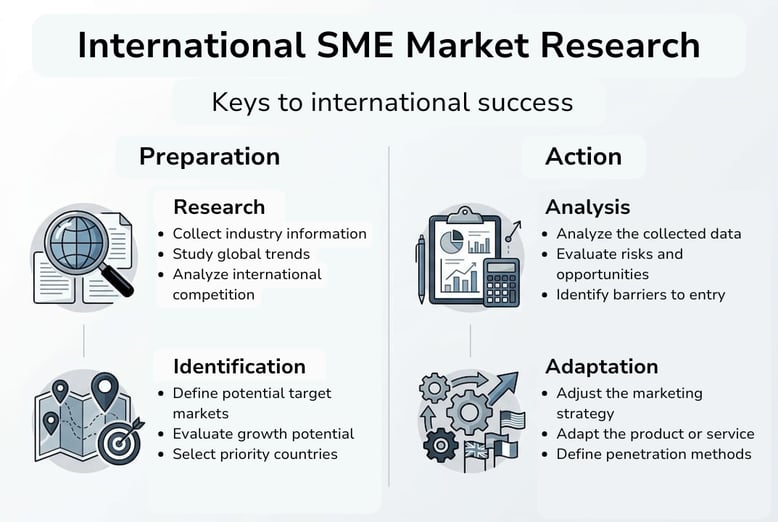
Structuring international market research means avoiding drowning in a mass of information without knowing what to do with it. Here's a clear process, adapted to the constraints of SMEs and startups.
-
Define your target market: choose one or two priority countries based on objective criteria (sector growth, cultural proximity, trade agreements).
-
Perform a PESTEL analysis: examine the Political, Economic, Social, Technological, Environmental and Legal factors of the target country.
-
Collect secondary data: sector reports, public databases, chamber of commerce studies. These sources are often free or inexpensive.
-
Conduct qualitative interviews: talk to local players, potential distributors, target customers. There's no substitute for hands-on experience.
-
Analyze local competition: identify market leaders, their prices, sales channels and weak points.
-
Validate your positioning: test your adapted offer before a large-scale launch.
Pro tip: the most effective SME export strategies for limited budgets rely on secondary research and digital tools. Google Trends, LinkedIn Sales Navigator and sector databases provide valuable insights at low cost.
| Method | Cost | Depth | Ideal for |
| Secondary research | Low | Medium | Initial validation |
| Qualitative interviews | Medium | High | Field understanding |
| Quantitative surveys | High | Very high | Mature markets |
| Digital tools | Low | Medium | SMEs/startups |
For a promising market in Australia or to explore export sectors in India, Expandys' support accelerates every step of the way with established expertise in the field.
Adapting market research to cultural and local specificities
Structuring a study is all very well. But adapting it to the cultural context of the target country often makes the difference between a successful launch and a wasted investment. Culture influences everything: the way customers perceive your offer, the channels they use, the arguments that convince them.
"To remember : Export cultural adaptation is identified as an absolute priority for SMEs and startups wishing to avoid costly international failures."
Here are some practical ways of integrating the cultural dimension into your study:
-
Use PESTEL analysis to map social and cultural factors from the outset
-
Recruit local partners who know market codes inside out
-
Test your marketing messages with a local panel before any launch
-
Observe local buying behavior rather than projecting your French assumptions
-
Adapt your product or service offering to the specific expectations of the market, not just your communications.
The most common mistake made by SMEs? Assuming that what works in France will work identically abroad. This projection bias is responsible for a large proportion of export failures. The five pillars of a successful internationalization strategy for SMEs systematically place local adaptation among the non-negotiable priorities.
Calling on local experts is not a luxury. It's a smart shortcut that saves you months of learning by doing. Successful exporters almost always rely on a solid local network to validate their assumptions and open the right doors.
Our perspective: what most SMEs don't know about international market research
After more than 17 years of supporting SMEs and startups in their international development, we have observed a recurring mistake: treating market research as an administrative formality rather than a living strategic tool.
Many companies produce a research document, put it away, and then act as if their home market and target market operate according to the same rules. This is where things go wrong. Exporting is riskier than the domestic market, and requires greater rigor at every stage.
What we see in successful SMEs is that they treat market research as an ongoing process, not as a one-off report. They update their data, adjust their positioning, and keep their finger on the pulse even after launch. Collaborative exporting by SMEs is a good illustration of this logic: sharing research and monitoring costs with other complementary companies helps maintain market intelligence without exhausting internal resources.
The real skill to develop is not producing a nice study. It's knowing how to read a foreign market with humility and curiosity, accepting that your French certainties aren't worth much on the other side of the world.
Going further: international market research support
Carrying out rigorous international market research requires time, resources and local knowledge that few SMEs possess in-house. That's precisely where specialized support can make all the difference.
For over 17 years, Expandys has been supporting SMEs and start-ups in their international expansion, with a network of local partners in the world's major markets. From market analysis to business networking, our teams will help you structure your approach, avoid costly mistakes and accelerate your development. Our Expandys SME customers can testify to concrete results: markets validated, subsidiaries created, international sales generated. Ready to take the plunge? Contact our experts for an initial discussion of your expansion project.
Frequently asked questions about international market research
What are the main risks of botched market research?
Inadequate market research exposes your company to direct commercial failure, an offer unsuited to the local market, and a loss of financial and human resources. Poorly prepared exports are systematically riskier than the domestic market.
Which digital tools are best suited to SMEs for international market research?
SMEs prefer secondary research and tools such as LinkedIn, Google Trends and free sector databases. These accessible digital tools provide solid insights without a large budget.
Is it necessary to hire a consulting firm to conduct a successful study?
No, but professional support enhances the rigor of analysis, improves local adaptation and significantly reduces risk. Local partners and experts are particularly valuable for SMEs approaching a market for the first time.
How do you choose your international target market?
PESTEL analysis, combined with an assessment of demand and regulatory obstacles, helps identify the most accessible markets. Prioritizing cultural adaptation when selecting a target market avoids many costly mistakes later on.
Don't leave your international expansion to chance.
Whether you're validating a new market or looking for a local distributor, our team is ready to accelerate your project and secure your return on investment.