

 Emmanuel Bisi
TL;DR:
- International sourcing is a strategic approach accessible to SMEs, targeting cost, quality and resilience.
-
It can reduce costs by up to 40%, access technologies and diversify suppliers.
-
Success is based on a four-phase methodology: identification, qualification, audit and contractualization.

Many SME managers are still convinced that international sourcing is the prerogative of large multinationals, those with dedicated teams and colossal purchasing budgets. It's a preconceived notion that costs a lot of money. In reality, international sourcing - the structured selection and management of suppliers abroad - has become a strategic lever available to SMEs and ambitious start-ups. This article explains exactly what this approach is, what concrete benefits it generates, how to implement it step by step, and what risks to anticipate to avoid falling into the classic pitfalls.
Table of contents
-
What is international sourcing?
-
What are the concrete benefits for SMEs and start-ups?
-
Methodology and key stages in international sourcing
-
Risk management: points to watch and solutions
-
Why the real challenge is no longer distance, but risk management and resilience
-
Get the support you need to secure your international sourcing
-
Frequently asked questions about international sourcing
Key points
What is international sourcing?
The term "international sourcing" is often mistakenly used as a synonym for simply importing or buying from abroad. This shortcut is misleading. It obscures the strategic and methodological dimension that distinguishes a professional approach from a simple one-off transaction.
According to SAP France, international sourcing is the strategic process of identifying, evaluating, qualifying and engaging suppliers located abroad to supply goods or services to a company, with the aim of optimizing costs, quality and supply chain resilience. This definition is important because it places the approach on three simultaneous and complementary dimensions: cost, quality and resilience. To ignore any one of them is to undermine the whole strategy.
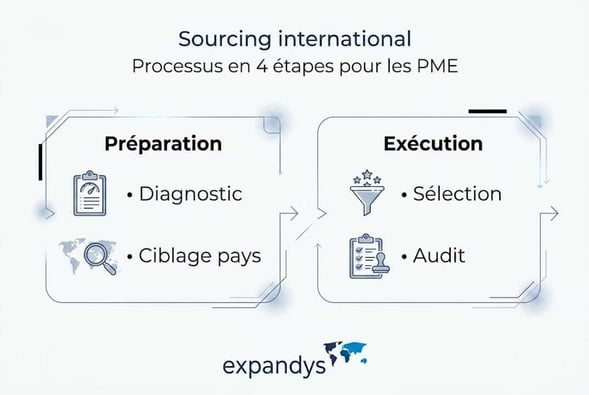
A clear overview of the different stages of international sourcing in a computer graphics presentation.
Why are SMEs and start-ups increasingly concerned? Because global supply chains have become fragmented, local markets are often too small to cover all raw material or component requirements, and international competition is driving down margins. An SME that ignores international sourcing often leaves significant gains on the table, to the benefit of better-organized competitors.
Here are the objectives typically pursued by an SME undertaking international sourcing:
-
Reducing purchasing costs by accessing markets where labor or raw materials are less expensive
-
Access to know-how or technologies unavailable locally, particularly in sectors such as electronics, technical textiles or composite materials
-
Diversification of supply sources to limit dependence on a single supplier or a single country
-
Enhanced quality thanks to specialized partners with strong sector expertise
-
Enhanced resilience in the face of logistical crises, shortages or geopolitical shocks
"International sourcing is not a luxury reserved for major accounts. It's a competitive necessity for any SME that wants to maintain its margins and capacity for innovation in a global context."
Common mistakes to avoid from the outset include choosing a supplier solely on the basis of an online catalog, neglecting quality certifications, or assuming that European standards automatically apply abroad. These shortcuts often cost far more than the savings hoped for. The importance for SMEs of structuring this approach from the outset cannot be underestimated.
What are the concrete benefits for SMEs and start-ups?
Let's move on to the real benefits of international sourcing, both in figures and in practice. Because beyond the rhetoric, measurable results are the best argument for convincing top management to allocate time and resources to this approach.
The most immediate and most frequently cited benefit is cost reduction. According to B-Dis, B2B distributors who adopt structured international sourcing see a 20-40% reduction in purchasing costs, combined with access to unique know-how and genuine supplier diversification. This figure is significant: for an SME with an annual purchasing budget of €500,000, it represents between €100,000 and €200,000 in potential savings.
But the benefits go far beyond mere financial gain.
For a start-up in its growth phase, access to new technologies or manufacturing techniques unavailable locally can represent a sustainable competitive advantage. For example, a manufacturer of innovative products can source components in Germany, raw materials in Brazil and have them assembled in Romania, combining quality, cost and geographical proximity according to its current priorities.
Securing the supply chain is another major benefit, often underestimated before the Covid-19 crisis. Companies that had diversified their supply sources weathered the global shortages of 2020 to 2022 with far less disruption than those dependent on a single supplier or country.
.png?width=1260&height=720&name=Untitled%20design%20(62).png)
Pro tip: Never rely exclusively on a single country or supplier, even if conditions seem ideal today. A successful international strategy is always based on diversification, with at least two sources for your critical purchases.
We should also mention a benefit that is often invisible in dashboards: the organizational learning effect. SMEs that engage in international sourcing develop in-house skills in negotiation, international contract management and risk analysis that reinforce their corporate culture in the long term.
Methodology and key stages in international sourcing
Understanding the benefits is all well and good. Knowing how to get them without getting trapped is even better. Here's the four-phase approach to successful international sourcing, whatever the size of your company.
This four-phase methodology is the reference in the field, and is based on a logical progression from identification to contractualization. According to B-Dis, the four essential phases are: identifying and pre-selecting suppliers, qualifying (ISO certifications, capacities, references, finances), carrying out a field audit for volumes over €50,000/year, then contracting with Incoterms, secure payments, penalties and CCI arbitration.
-
Phase 1 : Identification and pre-selection of suppliers. This stage consists of mapping potential supplier markets via professional directories (Alibaba, Europages, international sector fairs), bilateral chambers of commerce and business networks. The aim is to compile a shortlist of 5 to 10 serious candidates, eliminating from the outset those without a verifiable presence, customer references or documented production capacity.
-
Phase 2: In-depth qualification. Once the list has been drawn up, detailed checks are carried out on certifications (ISO 9001 for quality, ISO 14001 for the environment), actual production capacities, financial balance sheets (solvency, solidity), and verifiable customer references. At this stage, standardized supplier questionnaires and structured discovery calls are your best allies.
-
Phase 3 : Field audit. This stage is non-negotiable for any purchasing volume in excess of €50,000 per year. An on-site physical audit validates what commercial documents don't always show: actual production conditions, compliance with social and environmental standards (CSR), the actual quality of equipment, and the supplier's management culture. A supplier who refuses a field audit is an immediate red flag.
-
Phase 4 : Contractualization. The contract must include precise clauses on Incoterms (which define the distribution of risks and logistics costs between buyer and seller), secure payment terms (letters of credit, payment on delivery), late payment penalties, quality guarantees and arbitration clauses in the event of a dispute, preferably under the aegis of the International Chamber of Commerce (ICC).
Pro tip: Even for suppliers you've known for several years, plan a requalification audit every two to three years. A partner's production conditions and financial health can change rapidly, especially in emerging markets undergoing rapid transformation.
Risk management: points to watch and solutions
Once the process has been detailed, it remains crucial to anticipate what can go wrong, and to arm oneself accordingly. International sourcing is not without its pitfalls, and SMEs that underestimate the risks expose themselves to costly disruption.
The major risks to be aware of are
-
Quality risk: a supplier may undergo internal restructuring, change subcontractors or reduce manufacturing standards without informing you. Non-compliance can lead to product recalls, customer penalties and significant loss of reputation.
-
Regulatory risk: European standards (CE, REACH, RoHS) do not automatically apply to your foreign suppliers. Non-compliance with customs regulations can result in your goods being blocked from entering the country, and in fines.
-
Exchange rate risk: SMEs purchasing in dollars or yuan are exposed to exchange rate fluctuations. A fluctuation of 10% can wipe out all gains on expected costs.
-
Supply disruption risk: Natural disasters, social conflicts or political decisions in a supplier country can interrupt your supply overnight.
-
Geopolitical risk: Trade tensions between major powers (United States, China, European Union) often result in additional customs duties or export restrictions that directly affect SMEs.
"The real threat to an SME in international sourcing is not always the supplier itself, but the environment in which it operates: shifting regulations, political instability, currency volatility."
According to SAP France, the risks associated with international sourcing can be mitigated by regular audits and specialized insurance, such as that offered by Bpifrance or Euler Hermes, with premiums ranging from 0.3% to 0.8% of the insured amount. This is a modest cost compared to the security they provide.
Practical solutions to be implemented include international insurance, double sourcing (maintaining at least two active suppliers per critical reference), currency risk hedging via forward contracts or currency options, and the systematic use of field audits with certified local firms.
Pro tip: Post-Covid, opt for a nearshoring strategy (suppliers in neighboring countries such as Morocco, Turkey, Poland or Romania) or friendshoring (politically and economically allied countries). This approach offers a better balance between cost, flexibility and resilience for SMEs that don't have the resources to manage ultra-complex supply chains across several continents.
Why the real issue is no longer distance, but risk management and resilience
For years, the conversation around international sourcing has been dominated by a single obsession: "low cost". Go for the cheapest supplier, as far away as possible, to maximize short-term margins. The limits of this model were brutally exposed during the pandemic and the logistical crises that followed.
What we have been observing for several years among the most successful SMEs is a marked shift towards a logic of control and resilience. As B-Dis points out, for SMEs undergoing an internationalization phase, it is advisable to prioritize nearshoring and post-pandemic friendshoring for resilience, rather than aiming for pure globalization. Field audits remain essential, as commercial declarations do not always reflect the reality of production and CSR practices.
The real differentiating skill today is no longer finding the cheapest supplier in Asia. It's knowing how to audit, qualify, contractually manage and monitor a diversified supplier ecosystem in real time. Collaborative exporting and digital supply chain monitoring tools now enable SMEs to manage this complexity without a huge team. The supplier's address is less important than the quality of your management process.
Get support to secure your international sourcing
Having explored strategy, it's time to turn knowledge into action. And the first lesson we've learned from supporting over 600 companies in their international development is that SMEs that go it alone waste an average of 18 months correcting avoidable mistakes.
Expandys helps you structure each stage of your international sourcing process: diagnosing your purchasing needs, identifying priority supplier markets, organizing field audits, reviewing contracts and securing financing. Thanks to our network of international partners active in over 30 countries, our customers gain access to reliable local resources without taking unnecessary risks. Discover our international support solutions and transform your sourcing into a sustainable competitive advantage.
Frequently asked questions about international sourcing
Is international sourcing right for SMEs with fewer than 50 employees?
Yes, many smaller SMEs benefit from international sourcing to access new supplier markets and reduce costs, as the strategic sourcing process can be adapted to small volumes with appropriate support.
What are the main pitfalls to avoid when sourcing internationally for the first time?
Failing to validate the supplier's real capabilities, neglecting insurance and underestimating regulatory barriers are the most critical mistakes, which are prevented by a rigorous four-phase methodology.
Is there any financial aid available for international sourcing by SMEs?
Yes, solutions such as Bpifrance and Euler Hermes offer export credit insurance with premiums ranging from 0.3% to 0.8%, specifically designed to secure the international operations of SMEs.
What are the major differences between international sourcing and straightforward importing?
International sourcing is part of a structured approach to selection, auditing, contractualization and risk management that goes far beyond the simple importation of goods, by making each foreign supplier an assessed and qualified strategic partner.
Recommendation
-
Collaborative export: The future of SME internationalization?
-
French SMEs: The Five Pillars of a Successful Internationalisation Strategy
Don't leave your international expansion to chance.
Whether you're validating a new market or looking for a local distributor, our team is ready to accelerate your project and secure your return on investment.