

 Emmanuel Bisi
Many managers reduce international business intelligence to a few Google searches or a subscription to a specialized magazine. This is a costly mistake. Competitive intelligence (CI) is a structured discipline, both offensive and defensive, which enables you to anticipate your competitors' moves, secure your partnerships and seize opportunities before your rivals in complex foreign markets. In this article, we'll explain what IE really means internationally, which levers to pull, which tools to use, and how to integrate it concretely into your expansion strategy.
Table of contents
-
Understanding international business intelligence
-
Strategic levers for conquering new markets
-
Methodology and tools for international business intelligence
-
Anticipating risks and capitalizing on opportunities with EI
-
Why do SMEs neglect business intelligence? Our analysis
-
Support for a successful international business intelligence strategy
-
Frequently asked questions about international business intelligence
Key points
Understanding international business intelligence
Business intelligence was not born yesterday. In France, the 1994 Martre report laid the foundations for an approach that is both offensive and defensive, quite distinct from industrial espionage. French EI combines legal information gathering, protection of information assets and strategic influence. The Anglo-Saxon version, known as Competitive Intelligence, places greater emphasis on competitive analysis, and often revolves around Business Intelligence (BI), which focuses on a company's internal data.
This distinction is fundamental for any manager engaged in international expansion. BI tells you what's going on inside your organization. EI tells you what's happening out there, in your target markets, among your competitors, in the regulatory and political spheres that can condition your success or failure abroad.
Here are the main thrusts of international EI:
-
Offensive : identify market opportunities before your competitors do, detect loopholes in their positioning, anticipate favorable regulatory changes.
-
Defensive : protect your know-how, secure your contracts and partnerships, prevent the risks of counterfeiting or industrial espionage.
-
Influence: build your reputation in a given market, participate in consortia or standard-setting bodies to influence the rules of the local game.
"SMEs are particularly vulnerable without dedicated IE, especially in times of geopolitical crisis or when entering a foreign market for the first time."
Simple intelligence, i.e. passively monitoring news in your sector, is not enough. It doesn't produce analysis. It doesn't lead to decisions. EW, on the other hand, transforms raw information into competitive advantage. To explore the pillars of a company's internationalization, it's essential to include IE right from the strategy design phase, not just along the way. Markets such as those in the Indo-Pacific region are a perfect illustration of the extent to which the success of expansion projects depends on a detailed understanding of local dynamics.
Strategic levers for conquering new markets
Once you've understood what EI really is, the practical question becomes: which levers should be activated first? According to best-practice recommendations for offensive EI, there are four main areas that structure a solid expansion approach.
-
Map local competition: identify not only the existing players, but also their alliances, suppliers, strategic customers and areas of weakness.
-
Anticipate geopolitical risks: assess political stability, regional tensions, regulatory developments and the risks of logistical or financial disruption.
-
Select reliable partners: go well beyond the first commercial contact to verify a potential partner's reputation, financial solidity and cultural alignment.
-
Adapt your offer to target markets: analyze cultural preferences, local regulatory constraints (standards, certifications, competitor legislation) and the specific expectations of target customers.
Let's take a concrete example. A French industrial SME wishing to set up in West Africa will need to take into account, from the outset, the risks of currency volatility, local distribution practices, compliance standards imposed by regional economic zones and the existence of local players protected by political relationships. Without prior mapping, it risks signing an unsuitable partnership or underestimating a competitor capable of copying its offering in a matter of months.
"Analyzing geopolitical risks, selecting reliable partners and adapting products and regulations are the pillars of a successful market entry."
To find out whether your company is truly ready for the international stage, we recommend carrying out a due diligence audit, including an assessment of internal capabilities for processing strategic information. The 2026 strategy guide for SMEs provides very concrete answers to the steps you need to take before taking the plunge.
The benefits of this structured approach are manifold:
-
Significant reduction in implementation errors.
-
More effective negotiation with local partners.
-
Faster access to local networks of influence.
-
Ability to reposition the offer even before entering the market.
International business intelligence methodology and tools
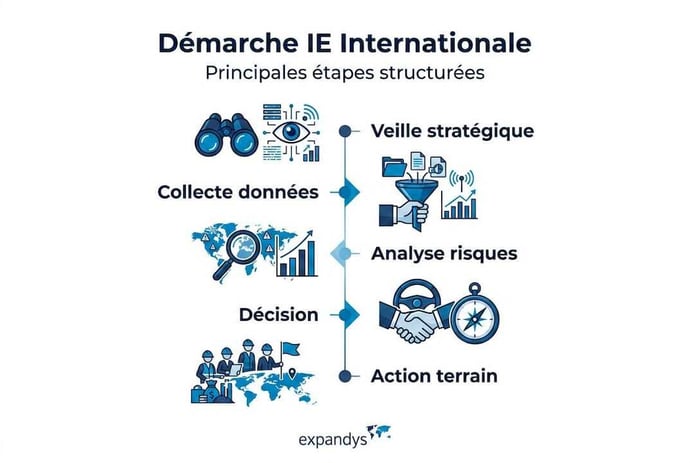
A sound international business intelligence strategy is based on a rigorous methodology. Here are the key stages in a successful approach:
-
Define precise objectives: in which market? For which strategic decision? Within what timeframe?
-
Collect multi-source data: local press, economic databases, sector reports, contacts in the field, institutional sources.
-
Cross-reference analyses with tried-and-tested frameworks such as PESTEL or CAGE to obtain both a macro-environmental and comparative vision.
-
Carry out due diligence before entering a market or signing a major partnership.
-
Produce an actionable summary enabling the management committee to make an informed decision within a reasonable timeframe.
|
Method |
Scope |
Preferred use |
Limits |
|
PESTEL |
Macro-environment |
Analysis of a target country or sector |
Does not cover cultural specificities |
|
CAGE |
Comparison between countries |
Market selection and prioritization |
Requires reliable comparative data |
|
Due diligence |
Micro-level partner |
Verification prior to contract or acquisition |
Long and costly process |
|
AI watch |
Continuous flow of information |
Early detection of weak signals |
D Possible algorithmic biases |
Artificial intelligence is now transforming the way teams conduct their intelligence. 67% of intelligence professionals are now trained to integrate AI into their analysis processes. Tools such as automated news aggregators, multilingual translation engines and semantic analysis platforms can now process huge volumes of information in a very short time.
However, tools do not replace human judgment. On-site analysis, local contacts, networks of experts and the ability to read between the lines of an official document remain irreplaceable. This is precisely why Expandys support combines a human approach with digital tools to produce relevant, actionable analyses.

Pro tip: never launch an IE initiative without first defining the strategic decision it is intended to support. A PESTEL analysis produced without a precise objective remains an academic exercise with no operational value. Ask yourself: what decision do I need to make in the next 90 days in this market?
When it comes to choosing a local partner, due diligence is particularly critical in markets where business practices, political relations and legal structures differ greatly from European standards.
Anticipating risks and taking advantage of opportunities thanks to Economic Intelligence
One of EI's most valuable contributions to international expansion is its ability to make companies proactive rather than reactive. In unstable contexts, particularly in sub-Saharan Africa or certain geopolitically sensitive areas, well-structured EI boosts companies' resilience and performance by enabling them to anticipate rather than suffer.
A case in point: a logistics company looking to expand into West Africa identified, through systematic EW analysis, a flaw in the positioning of its main regional competitor. The latter was neglecting a high-potential domestic transport corridor, leaving room for a rapid, differentiated entry. Without an IE approach, this opportunity would have been invisible.
Here's how to concretely organize the monitoring of risks and opportunities:
-
Set up a weekly geopolitical watch on target countries.
-
Monitor regulatory developments via official sources and local legal networks.
-
Monitor the movements of your direct competitors (new products, partnerships, key recruitments).
-
Integrate trusted local contacts able to provide unpublished information.
-
Keep a dynamic register of risks and opportunities, updated at least quarterly.
|
Geographical area |
Priority risks |
Opportunities detectable via EI |
|
West Africa |
Political instability, currency volatility |
Growth of middle class, need for infrastructure |
|
Southeast Asia |
Regulatory complexity, protectionism |
Rapid digitization, opening up to B2B services |
|
Latin America |
Corruption, legal instability |
Energy transition, agri-food sector |
|
Eastern Europe |
Geopolitical tensions, customs risks |
Manufacturing industry, skilled subcontracting |
Pro tip: Set up a network of "local watchdogs" in each target market - consultants, lawyers or former local executives who can alert you to changes in regulatory or political direction before they become public knowledge. This human intelligence is often faster and more reliable than any algorithm.
To compare different models of international expansion and assess which is best suited to your context, IE plays a decisive role in the selection and validation phase.
Why do SMEs neglect business intelligence? Our analysis
After more than 17 years of supporting companies in their international development, we have observed a persistent paradox: the SMEs that need business intelligence the most are precisely those that use it the least. Why is this?
The first reason given is cost. Many managers imagine that EW is reserved for large groups with dedicated units and substantial budgets. But this is not the case. A structured EI approach can be put in place with limited resources, provided it is precisely targeted at the company's real strategic decisions. The real cost is that of inaction: a poorly selected market, a failing partner or an unanticipated geopolitical crisis can represent losses far greater than the investment in prior analysis.
The second reason is perceived complexity. Many managers think that you need to be an expert in strategic analysis to practice EI. In reality, many of the tools and methods available today are accessible, thanks in particular to AI and intelligence platforms. What's missing is not the tools, but the discipline to transform information into decisions.
The third reason, and undoubtedly the most profound, is cultural. French companies have long given priority to product excellence over the ability to analyze their competitive environment. They mistakenly believe that the quality of their offering is enough to win over a foreign market. Experience shows the opposite: the best product often fails when faced with a competitor who is less good but better informed.
Our conviction, after accompanying more than 600 customers in their international expansion, is that EI is not a luxury. It's a prerequisite for survival in markets where information travels fast and windows of opportunity close as quickly as they open. Find out more about our integrated approach to international business.
Support for a successful international business intelligence strategy
Implementing an international business intelligence strategy requires method, resources and expertise in the field. That's exactly what we've been offering at Expandys for over 17 years.
Our teams support SMEs and ETIs in all phases of their expansion, from initial market research to the selection of reliable partners, including the creation of subsidiaries and regulatory compliance. Backed by a network of international partners via Globallians and experience in over 600 customer projects, we transform strategic information into measurable competitive advantage. Read our customer testimonials to see how this approach has generated concrete results, then discover Expandys to assess how we can support you right now.
Frequently asked questions about international business intelligence
Which companies are most in need of international business intelligence?
Mainly SMEs and ETIs seeking to secure their development in new markets, as they are the most vulnerable without dedicated business intelligence in the face of geopolitical crises and local competitive complexity.
What's the difference between economic intelligence and business intelligence?
Business intelligence integrates competitive intelligence, geopolitical risks and external analysis, whereas BI focuses solely on a company's internal data, making it a complementary tool but insufficient on its own for international business.
What are the concrete benefits for a company committed to international business intelligence?
A well-managed EI approach helps to anticipate risks, detect opportunities more quickly and secure expansion, because IE boosts resilience and performance through anticipation rather than reaction.
What tools and methods are generally used?
Companies rely on PESTEL and CAGE analyses, due diligence, artificial intelligence and the cross-referencing of field and digital data to produce actionable analyses.
Recommendation
-
French SMEs: The Five Pillars of a Successful Internationalisation Strategy
-
Collaborative export: The future of SME internationalization?
Don't leave your international expansion to chance.
Whether you're validating a new market or looking for a local distributor, our team is ready to accelerate your project and secure your return on investment.