

 Emmanuel Bisi
TL;DR:
-
70% of cross-border collaborations fail for lack of good international HR management.
-
Success depends on preparation, strategic alignment and cultural adaptation.
-
Using technological tools and partnering with experts optimize global HR expansion.
70% of cross-border collaborations fail due to poor international HR management. This figure, brutal as it is, reflects a reality experienced every day by HR managers and executives engaged in international expansion. Managing teams in several countries means juggling radically different cultures, legislation and expectations. This guide offers you a concrete method: from initial preparation to ongoing evaluation of results, each step is designed to reduce risks and maximize the performance of your international teams.

Table of contents
-
Understanding the challenges and preparing for international HR expansion
-
Aligning HR strategy with global and local objectives
-
Deploying effective processes and tools for your international teams
-
Measuring performance and continuously optimizing your international HR policy
-
Expert: why real success depends on structuring, but also on the courage to adapt
-
Expandys solutions for controlled international HR management
-
Frequently asked questions
Key points
Understand the challenges and prepare for international HR expansion
Before deploying anything abroad, it's important to understand why so many multinational HR projects fail. The answer often lies in a lack of structured preparation. International HR management involves aligning global objectives with local requirements, which presupposes a clear vision from the outset.
The three major issues to anticipate are cultural diversity, legal compliance and expatriate management. Each of these pillars can, if neglected, undermine your entire expansion. A company that imposes its French HR practices on a Japanese subsidiary without adaptation risks internal conflict, resignations and even legal sanctions.
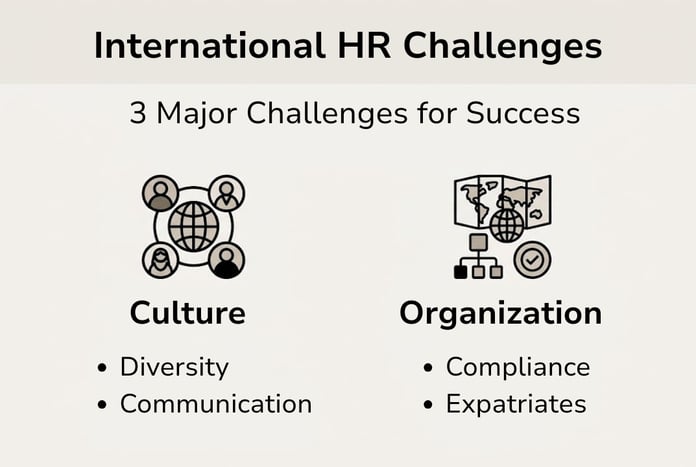
To assess your level of preparedness, here are the essential skills and resources:
International HR challenges are often underestimated in the planning stages. Yet companies that invest in ongoing regulatory monitoring and cross-cultural training before setting up operations significantly reduce their risk of failure.
Here are the top priorities for getting off to a good start:
-
Map labor legislation in each target country
-
Identify key cultural differences that impact management
-
Appoint a local HR manager or external partner from the outset
-
Define a global HR governance framework before entering the market
Pro tip : Before recruiting internationally, consult the strategies for international success to check whether your organization is really ready for international expansion. Many companies jump the gun and pay dearly for it.
Align HR strategy with global and local objectives
With the fundamentals in place, it's time to move on to strategic alignment. Strategic HR alignment involves global standardization and local adaptation. This is a constant tension that every international HR manager must learn to manage with discernment.

Some elements need to remain uniform across all your entities: corporate values, code of ethics, performance evaluation criteria. Others, on the other hand, absolutely must be adapted: remuneration levels, leave policies, management styles and even feedback methods.
Here's how to roll out your HR strategy from head office to subsidiaries in 5 steps:
-
Define the non-negotiable common base (values, ethics, global objectives)
-
Identify areas for adaptation by country or region
-
Involve local managers in the co-construction of adapted policies
-
Validate adaptations with local legal and HR teams
-
Document and centralize policies in a system accessible to all
The debate between HR centralization and decentralization is a recurring one. Here's a clear comparison:
IHRM (International Human Resources Management) best practices recommend a hybrid model: a strong global framework, with local latitude. International HR outsourcing can also be an effective solution for managing this complexity without overloading your in-house teams.
Pro tip : When deciding between adaptation and standardization, ask yourself this question: does this practice affect the local culture or regulations? If so, adapt. If it affects values or overall performance, standardize. You can also explore export HR workflows to structure these decisions in a systematic way.
Deploy effective processes and tools for your international teams
This theoretical alignment must then be translated into concrete processes using appropriate tools. The use of multi-country technologies is crucial for payroll, compliance and cross-cultural training. Without a solid technological infrastructure, even the best HR strategy remains a dead letter.
Here's a 5-step approach to deploying a multi-country HR policy:
-
Map existing processes in each country to identify gaps
-
Select a global HR platform integrating multi-currency payroll, talent management and compliance
-
Train local teams in common tools and policies
-
Set up a cross-cultural preparation program for expatriates and managers
-
Define monitoring indicators from the outset to drive results
HR technology solutions available in 2026 enable centralized payroll, automated regulatory compliance and global talent management from a single interface. This saves considerable time and increases reliability.
For mobile teams, the essential points to cover are :
-
Cultural preparation before departure (language, social codes, professional practices)
-
Settling in support (housing, taxes, family)
-
Regular follow-up during the assignment with a dedicated contact person
-
Structured return plan to capitalize on experience gained
"Key statistic: The cost of a failed expatriate assignment can reach $1.25 million per case. Investing in intercultural preparation is not an expense, it's insurance."
EOR (Employer of Record) solutions also represent a powerful option for quickly hiring in a new country without setting up a subsidiary, while remaining compliant with local laws.
Measure performance and continuously optimize your international HR policy
All that remains is to ensure that your actions bear fruit. Ongoing evaluation is the key to transforming an international HR policy into a sustainable competitive advantage.
The KPIs (key performance indicators) to be monitored as a priority are :
-
Employee engagement rates by country and by team
-
Retention rate for key international positions
-
Productivity measured against local targets
-
Expatriation and internal mobility success rates
-
Recruitment time and cost per hire in each country
To organize feedback, plan quarterly reviews with local managers, anonymous engagement surveys and annual mobility reviews. This data should feed into a continuous improvement process, not simply fill out dashboards.
"Stagility", a combination of stability and agility, is recognized as a key factor by 72% of international HR leaders. Companies that apply it adapt their processes without losing their overall coherence."
International benchmarks show that the most successful international organizations do not seek perfection from the outset. They build rapid feedback loops and correct in real time.
Pro tip: To detect signs of misalignment early on, keep an eye on three warning signs: a sudden rise in turnover in a subsidiary, a drop in productivity not explained by local economic factors, and an increase in conflicts between head office and field teams. These three indicators almost always precede an HR crisis. Collaborative export can also help you maintain cohesion between dispersed teams.
Expert: why real success depends on structuring, but also on the courage to adapt
Having covered all the practical aspects, let's take a strategic step back. There is a strong temptation in large organizations to standardize everything in order to simplify management. This is understandable. But the temptation to standardize often undermines cohesion and overall success.
The HR teams that succeed internationally are not those with the best tools or the most sophisticated processes. They are the ones who have the courage to question their usual practices when the local context demands it. A directive management style may work perfectly in France, but be perceived as disrespectful in Scandinavia.
Agile management means accepting that your international HR policy is a living document, not a bible set in stone. Companies that revise their practices twice a year systematically outperform those that freeze them in place.
Our differentiating tip: invest early in processes, but invest just as much in intercultural animation. Organize regular exchanges between teams from different countries, create common rituals, value diversity as an operational asset rather than a constraint. This is what makes the difference between an expansion that lasts and one that runs out of steam after 18 months. To take this a step further, the differences between recruitment in the UK and France are a perfect illustration of why local adaptation is not optional.
Expandys solutions for controlled international HR management
Optimizing your international HR management requires expertise that few in-house teams possess on their own. This is precisely where a specialized partner makes all the difference.
With over 17 years' experience and more than 600 customers, Expandys provides you with international HR solutions covering recruitment, compliance, expatriate management and the integration of multi-country tools. Our teams know the legal and cultural specifics of each market, so you can avoid costly mistakes. Read Expandys customer stories to discover how companies like yours have successfully expanded their international HR operations with our support.
Frequently asked questions
What are the biggest challenges in international HR management?
The biggest challenges are cultural differences, compliance with local laws, managing expatriates and coordinating multi-country tools. Each of these factors, if neglected, can jeopardize an entire expansion.
How can we measure the success of an international HR policy?
By analyzing indicators such as commitment, retention and productivity, as well as the success rate of international assignments. These KPIs need to be tracked by country, so that any discrepancies can be detected quickly.
Should HR practices be standardized or adapted internationally?
We need to combine global standardization with local adaptation: standardizing values and performance criteria, and adapting compensation, leave and management policies to cultural and legal contexts.
What tools are recommended for managing multi-country payroll?
Multi-country technologies integrating multi-currency payroll, automated compliance and time management are essential. EOR solutions also offer a fast, compliant alternative for new establishments.
Why is investment in cross-cultural training crucial?
Cultural training reduces the failures and costs associated with international assignments, which can reach $1.25 million per case of failure. It's one of the fastest returns on investment in international HR.
Recommendation
Don't leave your international expansion to chance.
Whether you're validating a new market or looking for a local distributor, our team is ready to accelerate your project and secure your return on investment.



%20(7).png)