
 Emmanuel Bisi
A poorly prepared international HR assignment can cost between two and five times an expatriate's annual salary, not to mention the damage to team cohesion and corporate reputation. Yet many expatriations fail for lack of a structured workflow, clear processes and serious intercultural preparation. For HR directors and export managers in an internationalization phase, building a robust HR workflow is not a luxury, it's a condition of survival. This practical guide takes you step by step, from initial preparation to long-term implementation, to turn your export assignments into measurable successes.

Key points
| Point | Details |
| Essential structured workflow | A well-planned HR export workflow reduces the risk of human and financial failure on international assignments. |
| The right tools and skills | Use digital tools and develop intercultural skills to boost export HR efficiency. |
| Anticipate and control risks | Identify recurring hazards to adapt and strengthen your export HR management. |
| People management and training | Soft skills and training are the cornerstones of successful international HR management. |
Prepare your HR workflow before exporting
Before deploying any resources abroad, preparing the HR workflow is crucial to everything else. Aligning HR strategy with export objectives is not an administrative formality; it's the foundation on which every international mobility decision is built.
Start by auditing your current tools. Many companies use HR software designed for the domestic market, which is ill-suited to the demands of international mobility. Here are the tools you should consider first:
- Workday: talent management, international payroll, multi-country compliance
- SAP SuccessFactors: performance monitoring and global mobility
- CFE (Caisse des Français de l'Étranger) platform: social security coverage for French expatriates
- Bamboo HR: onboarding and document management for dispersed teams
Next, assess the skills of your HR team. International management requires profiles capable of navigating local legislation, cultural differences and compliance requirements. Essential skills include fluency in professional English, knowledge of bilateral tax treaties, and the ability to manage expatriation or secondment contracts.
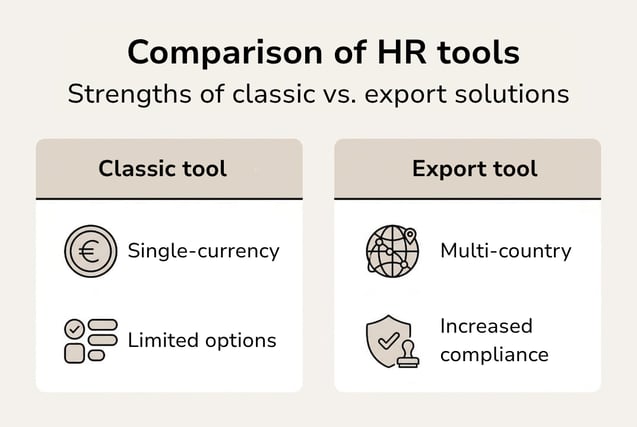
This comparison illustrates why migrating to export-ready tools is not an option, but an operational necessity. To take your SME's international strategy a step further, it's a good idea to integrate HR issues right from the strategic planning phase.
Pro tip: never neglect intercultural training. A technically excellent employee may fail abroad simply because of a lack of understanding of local cultural codes. Plan at least two days' training before departure.
Implementing HR workflow in an export context
Once the prerequisites have been identified, let's move on to practical implementation. Deploying an export HR workflow follows a sequential logic that you can't safely bypass.
Here are the key steps to follow in order:
- Define the legal status: secondment, expatriation or local contract - each status implies different obligations.
- Draft appropriate contracts: include clauses on return, social protection and remuneration in local currency.
- Activate social security coverage: complete expatriation HR checklist, including health, pension and provident insurance.
- Organize local onboarding: presentation of teams, training in local practices, access to tools.
- Set up performance monitoring: clear objectives, regular reviews, indicators adapted to the local context.
- Plan reintegration: as soon as you leave, not six months before your return.
International recruitment has its own specificities that many companies discover too late, particularly with regard to legal deadlines and the cultural expectations of local candidates.
Successful SME exporters have one thing in common: they treat international performance monitoring as rigorously as their financial indicators.
Pro tip: draw up a reintegration plan from day one of the assignment. Employees who know that a rewarding position awaits them on their return are significantly more committed and successful for the duration of their assignment.
Anticipating risks and common mistakes
After implementation, it's crucial to anticipate the pitfalls. The risks associated with export HR workflow are human, financial and regulatory, and they often add up.
The most common international HR challenges include poorly anticipated cultural differences, varying labor laws in different countries, and an assignment failure rate that remains a cause for concern in many sectors. An aborted assignment is costly, not only financially, but also in terms of motivation of remaining teams and employer image.
Here are the key points to check systematically:
- Compliance with local labor laws (legal working hours, vacations, dismissal)
- Validity of visas and work permits before each departure
- Effective social security coverage in the host country
- Remuneration policy in line with the local cost of living
- Cross-cultural preparation of employees and their families
-
Regular communication with head office
Collaborative exporting offers an interesting alternative for SMEs wishing to pool HR risks while gaining access to international markets. Sharing resources and expertise reduces each company's individual exposure.
Regulatory non-compliance remains the most costly mistake. A French company deploying an employee to Germany without complying with local secondment rules exposes itself to significant fines and retroactive tax reassessments.
Check, adapt and maintain the export HR workflow
Once the risks have been identified, it's time to think about continuous improvement. An HR export workflow is never static: it evolves with markets, regulations and teams.
Here's how to structure your audit process:
- Comprehensive annual audit: review of all contracts, statutes and social security cover in force.
- Gathering feedback: structured interviews with employees on assignment and their managers.
- Regulatory update: legal watch in each country of operation, at least every six months.
- Indicator review: adjust HR KPIs according to observed results and updated objectives.
The strategic and operational skills of managers play a central role in the adaptability of HR workflow. An organization that learns from its international experiences builds a sustainable competitive advantage.
Points to re-evaluate regularly:
- Relevance of HR tools to new functionalities available
- Suitability of intercultural training for current target countries
- Effectiveness of onboarding and reintegration processes
- Level of satisfaction of internationally mobile employees
- Compliance with local and European legislation
Knowing whether your company is ready for international expansion also depends on its ability to question its own HR processes. The best organizations don't try to be right, they try to improve.
Continuous adaptation is not a sign of organizational weakness. On the contrary, it's the hallmark of companies that last in international markets.
Our perspective on export HR workflow
After more than 17 years of assisting companies in their internationalization, we have observed one constant: organizations that fail in exporting generally don't lack financial resources. What they lack is human preparation.
International management cannot be improvised. Soft skills, ongoing training and intercultural team-building workshops are not options reserved for large groups. They are affordable investments that radically change results in the field.
We've seen SMEs with modest budgets succeed brilliantly internationally because they invested in training their managers. And we've seen well-endowed companies fail because they treated the human dimension as a secondary variable.
Our conviction: the most effective export HR workflow is the one that puts people before process. Tools and checklists are supports, not solutions. Export HR support must be adapted to each context, each culture, each team. There is no universal model, only solid principles applied with intelligence and sensitivity.
Discover our solutions for export HR optimization
Setting up a high-performance export HR workflow requires time, expertise and in-depth knowledge of target markets. At Expandys, for over 17 years we have been helping companies of all sizes to structure their international HR processes, from recruitment to reintegration.
Our teams are involved in the entire export HR cycle: definition of statutes, legal compliance, local onboarding and performance monitoring. Our Expandys customer feedback provides concrete examples of how SMEs and major groups have transformed their export missions into lasting successes. To find out how our export HR services can be adapted to your situation, contact us for a no-obligation initial discussion.
Frequently asked questions about HR export workflow
Which HR tools are best suited to managing an export workflow?
Specialized international tools such as Workday and CFE platforms facilitate talent management, legal compliance and international mobility far better than traditional domestic solutions.
How can I avoid failure on an international HR assignment?
Prepare a comprehensive HR checklist covering contracts, social security, local onboarding and reintegration plans, and systematically include intercultural preparation before each departure.
What HR management skills are essential for export?
Soft skills and intercultural adaptation are essential, along with fluency in English and team-building skills, to effectively manage international teams.
What are the main risks involved in the export HR workflow?
The most critical international HR challenges are human and financial failure of assignments, local legal non-compliance and lack of serious intercultural preparation.
Don't leave your international expansion to chance.
Whether you're validating a new market or looking for a local distributor, our team is ready to accelerate your project and secure your return on investment.

Recommendation
.png)

%20(19).png)