

 Emmanuel Bisi
TL;DR:
-
Establishing a successful business requires a structured approach: market research, cultural adaptation, legal and financial choices.
-
Choosing the right entry method, such as export or partnership, limits risks and optimizes control.
-
Preparation, experience and the use of digital tools are key to international success.
By 2022, more than 14,000 French companies were operating internationally, yet a majority of them have underestimated the complexity of the process. Many managers believe that exporting a few products is enough to "have a presence" in a foreign market. This is a costly mistake. Successful establishment is based on a rigorous sequence: market research, choice of entry method, cultural adaptation, legal structure and financial management. This guide is aimed at SMEs, start-ups and managers who want to structure their internationalization approach methodically, avoiding the classic pitfalls and maximizing their chances of lasting success.
Contents
-
Understanding the key steps to successful internationalization
-
Comparing methods of entering foreign markets
-
Critical success factors and new trends
-
Avoiding the pitfalls: common mistakes and risk management
-
Our perspective on international expansion strategies
-
Accelerate your expansion with customized support
-
Frequently asked questions
Key points
Understand the key stages of successful implementation
Having set out the need for a structured approach, let's move on to the fundamental steps that guide any successful international set-up. Many companies rush through the stages out of enthusiasm or competitive pressure. The result: they arrive in an ill-prepared market, with an unsuitable offering and skyrocketing costs.
Here are the five fundamental steps to follow in order:
-
Thorough market research. PESTEL, SWOT and competitive analysis is a fundamental step. It helps validate real demand, identify regulatory barriers and map local competition before investing a single euro.
-
Strategic selection of target country. Market size, political stability, cultural and linguistic proximity, logistical access: these criteria must be weighted according to your sector and available resources. Don't choose a market just because it's "in".
-
Adapting your offer. A product that works in France won't necessarily work in Southeast Asia or Latin America without adjustments. Price, packaging, after-sales service, local standards: everything may need to be revised.
-
Choice of legal structure. Representative office, subsidiary, branch or joint venture: each option has very different tax, social and operational implications. This choice determines your future flexibility.
-
Logistical and financial set-up. Cash flow management in foreign currencies, currency risk hedging, local supply chain: these elements need to be anticipated well before the launch.
The five pillars of a successful international strategy provide a useful complementary framework for SMEs.
Pro tip: systematically use the PESTEL, SWOT and OLI (Ownership, Location, Internalization) frameworks to secure your analyses. These tools are not just for large groups. They enable an SME with 20 employees to make decisions as rigorous as those of a multinational, provided they are applied with honesty and without confirmation bias.
Comparing methods of entering a foreign market
Once the strategic sequence has been understood, the next step is to choose the best gateway to the foreign market. This is often where managers make the most costly mistake: choosing a mode of entry that is too ambitious too early, or on the contrary, too passive to generate real growth.
Entry methods vary widely in terms of cost, risk and level of control. Here's a comparative table to help you make your choice:
A few key principles to bear in mind when choosing your entry strategy:
-
A start-up with few resources should start with direct export or a local partnership before considering a subsidiary.
-
The Uppsala model recommends gradual internationalization: start with markets that are culturally and geographically close, then expand.
-
So-called "born global" companies (often in the digital or tech sectors) can skip stages, but they need to have a highly differentiated value proposition.
-
A joint venture is particularly useful in markets where local regulations require local equity participation.
Pro tip: Validate your offer and positioning via a low-risk entry mode before internalizing your operations. Too many companies set up a subsidiary before they have even confirmed that their offer will find takers in the target market. Test first, structure later.
Critical success factors and new trends
Once you've chosen your entry point, what are the factors that really make the difference? Case studies and benchmarks converge on several often overlooked levers.
The first factor is experience and preparation. SMEs whose managers have already had international experience, even if only partial, are significantly more successful. It's not a question of innate talent, but of the ability to anticipate the unknown and quickly adapt decisions.

Second factor: differential growth. Exporting SMEs grow twice as fast as purely domestic companies. This figure should be enough to convince skeptics that internationalization is not a luxury reserved for large groups.
Third factor: digital tools and AI. Strategies incorporating AI now enable SMEs to carry out market analyses, demand forecasts and logistical optimizations that were the preserve of large companies ten years ago. It's a major lever of competitive equity.
Here are the most documented success factors:
-
Solid local network : a reliable local partner or relay reduces adaptation time and opens doors inaccessible from Paris or Lyon.
-
Organizational agility : the ability to quickly adjust the offering, price or distribution channel according to feedback from the field.
-
Proactive risk management: currency hedging, market diversification, continuous regulatory monitoring.
-
Clear performance indicators: define precise KPIs (sales volume, market share, time to return on investment) from the outset, so you can steer your business objectively.
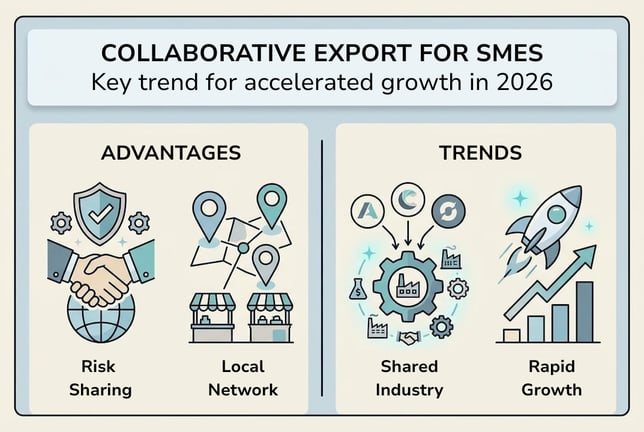
Collaborative exporting between SMEs in the same sector will also be a major trend in 2026, enabling them to pool the costs of market research, logistics and local representation.
Avoiding the pitfalls: common mistakes and risk management
Last but not least, understanding how to avoid the main pitfalls will help you to secure and sustain your internationalization process. After all, there is no shortage of obstacles, many of which can be avoided with rigorous preparation.
"The failure rate of poorly prepared internationalization projects is close to 70%. This statistic should be a wake-up call, not a fatality.
Here are the five most common mistakes observed in the field:
-
Choosing the wrong market. Attracted by the size of a market or a one-off opportunity, some managers overlook real regulatory, cultural or logistical barriers. A large, difficult market is worth less than a medium-sized, accessible one.
-
Underestimating cultural differences. Communication, negotiation, decision-making times and customer expectations vary radically from one country to another. What is perceived as efficiency in France may be experienced as rudeness elsewhere.
-
Neglecting to validate local demand. Many companies export their offer without checking whether it meets a real need in the target market. Even a little field research can avoid costly mistakes.
-
Doing everything too quickly. Impatience is the enemy of internationalization. Opening three markets simultaneously with limited resources almost guarantees failure on all fronts.
-
Lack trusted partners. Relying on a local distributor or partner without first checking their reputation, financial strength and strategic alignment is a major risk.
To objectively assess your level of preparation, consult our analysis of French SMEs ready for international markets.
Pro tip: Limit yourself to one or two markets at a time during your initial expansion phase. Master one market, document what you've learned, then replicate the model. This test & scale sequence is systematically more effective than all-out expansion.
Our perspective on international expansion strategies
After more than 17 years of helping SMEs and startups expand internationally, it's clear that the main obstacle is not a lack of financial resources. It's haste.
The companies that achieve lasting international success share a common characteristic: they are willing to test before structuring. They have validated their offer in a first market, learned from their mistakes without jeopardizing the whole organization, and then replicated with method.
The other unspoken truth: the local partner is often more valuable than the subsidiary itself. Many managers associate total control with guaranteed success. But this is not true. A good local partner will open doors for you in six months, whereas it would take a subsidiary two years to break through on its own.
We see it regularly with our customers: those who consult the best pillars of internationalization and apply them with discipline progress twice as fast as those who improvise. Agility trumps big structure. Always.
Accelerate your expansion with tailor-made support
Stay ahead with professional support tailored to your international ambitions. Theoretical advice has its value, but it's in execution that successes and failures are played out. For over 17 years, Expandys has been assisting SMEs, start-ups and major groups in every stage of their international expansion: market research, setting up subsidiaries, local recruitment, administrative management and business contacts.
Our international network of partners, including Globallians, enables us to intervene rapidly in your target markets with trusted local contacts. Over 600 customers have already benefited from our expertise. Find out more about how we work by reading the testimonials of our Expandys customers, or contact us directly for a personalized diagnosis by visiting expandys.com.
Frequently asked questions
What are the least risky ways for SMEs to set up business?
Direct export remains the safest and most flexible entry method for an SME starting out internationally. Partnerships with local agents or distributors are also a low-risk alternative for testing a market before making a bigger commitment.
How do you choose the right country to set up in?
The choice of target country is based on a rigorous PESTEL and SWOT analysis, combining market attractiveness, political stability, cultural proximity and regulatory accessibility. Avoid relying solely on market size without assessing the real barriers to entry.
Why do so many companies fail internationally?
The main causes are underestimation of cultural and regulatory differences, combined with a lack of validation of local demand. 70% of international failures are the direct result of insufficient preparation in these two areas.
Can AI help an SME set up its business?
Yes, artificial intelligence tools today enable SMEs to analyze demand, optimize logistics and reduce barriers to access to new markets. AI is accelerating SME exports, particularly in the fields of demand forecasting and logistics management - areas previously reserved for large companies.
Don't leave your international expansion to chance.
Whether you're validating a new market or looking for a local distributor, our team is ready to accelerate your project and secure your return on investment.

Recommendation
.png)
.webp)
.png)